Does your Ford AC blow warm at idle but return to cold air as soon as you start driving? This frustrating problem can become especially noticeable when you're stopped at a traffic light, waiting in a parking lot, or sitting in Miami traffic on a hot afternoon. One common explanation is inadequate airflow through the air-conditioning condenser while the vehicle is stationary. A malfunctioning cooling fan, low refrigerant, a refrigerant leak, compressor trouble, or a restricted condenser can all contribute to inconsistent cooling. Although certain driving conditions can temporarily affect AC performance, a system that repeatedly blows warm air at idle may need professional attention. Understanding the symptoms can help you determine when to schedule Ford AC diagnostics rather than assuming the system simply needs a refrigerant recharge.
For Ford owners around Miami, Westchester, Fontainebleau, and Sweetwater, reliable air conditioning is an important part of comfortable daily driving. Whether you drive an F-150, Explorer, Escape, Expedition, or another Ford, understanding why your AC cools better while moving can help you recognize when a professional Ford AC repair in Miami, FL may be necessary.
Quick Answer: Why Does My Ford AC Blow Cold While Driving but Warm at Idle?
One common cause is insufficient airflow across the AC condenser when the vehicle is stopped. While driving, outside air passes through the condenser and helps remove heat from the refrigerant. At idle, the system relies more heavily on cooling fans to move air through the condenser.
If a fan isn't operating correctly, the condenser is obstructed, or the AC system has another fault, cooling performance may decrease until the vehicle starts moving again.
Other possible causes include low refrigerant, refrigerant leaks, compressor performance problems, and malfunctioning pressure sensors or electronic controls.
The exact cause requires diagnosis. A Ford that repeatedly loses cooling while stationary doesn't automatically need a new compressor or more refrigerant.
Why Does Your Ford AC Work Better When the Vehicle Is Moving?
Your Ford's air-conditioning system moves heat from inside the cabin to the outside air.
Refrigerant circulates through components such as the compressor, condenser, expansion device, and evaporator. Together, these parts help absorb heat from the cabin and release it outside the vehicle.
One of the most important components in this process is the condenser, which is typically positioned near the front of the vehicle.
How Airflow Helps the AC Condenser
The condenser needs sufficient airflow to release heat from the refrigerant.
While you're driving at road speed, air naturally flows through the vehicle's front grille and across the condenser.
When your Ford is stopped, that natural airflow decreases significantly.
Cooling fans help provide the airflow needed when the vehicle isn't moving.
If the cooling fan system isn't operating as intended, the condenser may struggle to release heat. Refrigerant pressures and temperatures can rise, reducing AC performance.
Once the vehicle begins moving again, additional airflow may temporarily improve cooling.
This explains why AC that gets cold on the highway but warm at stoplights often leads technicians to investigate condenser airflow and cooling fan operation.
Is Some Reduction in AC Cooling at Idle Normal?
Extremely hot weather, a sun-heated cabin, and extended idling can place additional demands on a vehicle's AC system.
Depending on the Ford model and operating conditions, you may notice some change in cooling performance while stationary.
However, air that repeatedly becomes noticeably warm at every stoplight, followed by a return to cold air when driving, may indicate a developing problem.
The most useful clue is whether the behavior is consistent and noticeably different from how the vehicle previously operated.
Common Causes of Ford AC That Blows Warm at Idle
Several air-conditioning and engine-cooling components can produce similar symptoms. Understanding the possible causes can help you describe the problem during your service appointment.
1. Malfunctioning Radiator or Condenser Cooling Fan
A cooling fan problem is one of the first possibilities technicians may investigate when AC works well at road speed but poorly at idle.
Depending on the Ford model, the AC condenser may share airflow from an electric radiator fan system or use another fan arrangement.
These fans help move air across the condenser when the vehicle is stopped or traveling slowly.
Possible problems include:
- A malfunctioning electric cooling fan motor.
- Electrical wiring or connector problems.
- A faulty fan relay or control module, where applicable.
- Fan-speed or control-command problems.
- Damaged fan shrouds or other airflow-management components.
A cooling fan may work intermittently, operate at an incorrect speed, or fail to turn on when needed.
At road speed, natural airflow can sometimes compensate for inadequate fan operation. When stopped, the problem becomes more noticeable.
However, the fan's behavior alone isn't proof that the fan motor needs replacement. A technician may need to test electrical commands, actual fan operation, and related components.
2. Low Refrigerant or a Refrigerant Leak
Refrigerant is essential to the air-conditioning system's ability to absorb and release heat.
If the refrigerant charge becomes too low, the system may not maintain normal cooling performance under demanding conditions.
Depending on the vehicle, low refrigerant can contribute to warmer air at idle, inconsistent cooling, or compressor operation that changes unexpectedly.
Potential leak locations include refrigerant hoses, fittings, seals, the condenser, and other AC components.
A refrigerant leak may develop gradually, making the loss of cooling performance more noticeable over time.
Adding refrigerant is not the same as repairing a leak. If refrigerant is escaping, simply topping off the system may provide only temporary improvement.
A professional inspection can help determine whether the charge is incorrect, whether a leak is present, and what repairs are appropriate.
3. AC Compressor or Compressor Control Problems
The compressor helps circulate and pressurize refrigerant through the air-conditioning system.
Depending on the vehicle, compressor operation may involve a clutch, variable-displacement controls, electronic regulation, or an electrically driven compressor.
If the compressor or its controls aren't working correctly, the AC may struggle to maintain cooling under certain operating conditions.
Some drivers notice that the air gets colder as engine speed increases. This can be a useful symptom to report, but it does not automatically mean that the compressor is failing.
Insufficient condenser airflow, an incorrect refrigerant charge, or a control problem can produce similar behavior.
A qualified technician can compare compressor operation with system pressures, temperatures, and electronic commands before determining whether the compressor requires repair.
4. Restricted Airflow Through the AC Condenser
A condenser doesn't need to be completely blocked to experience reduced cooling efficiency.
Dirt, road debris, leaves, insects, or damaged condenser fins may restrict airflow.
When the vehicle is moving, air passing through the front of the vehicle may help maintain cooling.
At idle, restricted airflow can become more noticeable because the cooling fans have less outside airflow to work with.
Damaged air dams, fan shrouds, or missing airflow seals can also affect how efficiently air moves through the condenser.
A technician can inspect the condenser and surrounding airflow components to determine whether a restriction is contributing to the problem.
5. AC Pressure Sensor or Electronic Control Faults
Modern Ford vehicles use sensors and electronic controls to manage AC performance and protect system components.
Depending on the model, the system may monitor refrigerant pressure, temperature, engine operating conditions, and other information.
An inaccurate sensor reading or control malfunction can affect compressor operation or cooling fan commands.
These issues may cause intermittent cooling or unexpected system shutdowns.
Diagnostic trouble codes and live vehicle data may help identify whether an electrical or electronic fault is involved.
6. Engine Cooling System Problems
The engine cooling system and air-conditioning condenser often depend on the same front-end airflow path.
A malfunctioning fan, restricted radiator airflow, or engine temperature problem may therefore affect both engine cooling and cabin air conditioning.
On certain vehicles, the AC system may reduce or disable compressor operation when engine temperatures or refrigerant pressures become excessive.
If your Ford's AC begins blowing warm air while the engine temperature gauge is also rising, the issue may be more serious than an ordinary AC comfort problem.
Follow the owner's manual instructions for any engine temperature warning, stop safely, and arrange assistance when necessary.
How Can You Tell Which AC Problem Your Ford May Have?
The way your air conditioning behaves can offer clues, although no single symptom confirms a particular repair.
AC Gets Warm at Stoplights but Cold on the Highway
This pattern often directs attention toward condenser airflow, cooling fan operation, refrigerant pressures, and compressor performance.
The fact that cooling improves as vehicle speed increases is useful information for a technician.
AC Gets Colder When You Rev the Engine
A noticeable change in cooling as engine speed increases may involve compressor operation, refrigerant conditions, or another system response.
However, compressor designs vary across Ford vehicles, and some models use electrically controlled compressors. Engine speed alone cannot identify the failed part.
AC Starts Cold but Gradually Becomes Warm
If the AC initially cools well but loses performance after extended operation, possible causes include refrigerant pressure problems, fan control issues, compressor faults, or other temperature-related conditions.
Note how long the system operates before the temperature changes.
Airflow From the Vents Becomes Weak
Weak airflow from the dashboard vents is different from strong airflow that has become warm.
A clogged cabin air filter, blower motor problem, air distribution fault, or evaporator icing may contribute to reduced airflow.
These problems should be evaluated separately from condenser airflow and refrigerant cooling performance.
AC Makes Clicking, Grinding, or Squealing Sounds
Unusual noises when the AC operates may involve a fan, compressor, belt-driven accessory, or another component.
An occasional operating sound is not automatically a malfunction, but new or severe grinding, squealing, or rattling deserves attention.
Turn off the AC and arrange an inspection if a significant mechanical noise develops.
Why Miami Heat and Humidity Make AC Problems More Noticeable
Air conditioning is especially important for everyday driving in South Florida.
High outside temperatures, strong sunlight, and humidity place additional demands on the system as it works to cool and dehumidify the cabin.
Heavy Traffic Around Miami
When you're driving through busy traffic, the vehicle may spend more time stationary or moving slowly.
This reduces natural airflow through the condenser and places greater importance on proper cooling fan operation.
A Ford with marginal condenser airflow may seem to cool normally at higher speeds but struggle during extended traffic delays.
Westchester and Fontainebleau: Frequent Stops and Short Trips
Drivers around Westchester and Fontainebleau may encounter frequent traffic lights, shopping-center parking lots, and short trips.
A hot cabin can take time to cool after the vehicle has been parked in direct sunlight.
However, if the AC consistently turns warm after the cabin has already cooled, especially when the vehicle stops, the pattern may indicate a system problem worth investigating.
Sweetwater: Highway and Local Traffic Changes
Drivers traveling around Sweetwater and nearby expressways may notice that AC performance improves at highway speeds but deteriorates when entering slower traffic.
That change in vehicle speed can help narrow the diagnostic process.
When scheduling service, explain whether the AC behaves differently during highway travel, neighborhood driving, and extended idling.
Humidity and Cabin Comfort
Your Ford's air conditioning does more than lower cabin temperature. It also removes moisture from the air.
If cooling performance decreases, the cabin may feel unusually humid or uncomfortable even when air continues flowing from the vents.
Reduced dehumidification can also affect how quickly some windows clear under certain conditions.
These symptoms are worth discussing during an AC diagnostic appointment.
Can You Improve Ford AC Cooling While Waiting at a Stoplight?
There are a few simple settings you can check from inside the vehicle without opening the hood or touching AC components.
- Confirm the AC is switched on. Make sure the air-conditioning function is active rather than relying on ventilation alone.
- Use MAX A/C or recirculation when appropriate. These settings can help cool a hot cabin by reducing the amount of outside air that needs to be cooled.
- Check your selected temperature. Make sure the climate controls aren't requesting warmer air.
- Notice whether the vent airflow remains strong. If the blower becomes weak, the issue may be different from warm air caused by condenser or refrigerant problems.
- Watch for dashboard temperature warnings. A rising engine temperature or overheating message may indicate a more serious issue.
- Record when the symptom happens. Note whether the AC becomes warm after a few minutes of idling, only in heavy traffic, or immediately after stopping.
These observations may help describe the problem, but changing climate settings won't repair a faulty fan, refrigerant leak, or failing compressor.
Important AC Safety: Don't Reach Near Cooling Fans or Open Refrigerant Lines
Electric cooling fans can start unexpectedly, including when the engine is off. Keep hands, tools, clothing, and other objects away from fans, belts, and moving underhood components.
Vehicle AC systems contain pressurized refrigerant that requires proper handling and specialized equipment. Don't disconnect AC lines, release refrigerant, or attempt to repair the refrigerant circuit yourself.
Avoid adding refrigerant or sealants simply because your AC blows warm at idle. Incorrect refrigerant quantities, incompatible products, and untreated leaks can create additional problems.
If your Ford also displays an overheating warning, produces steam, or develops severe mechanical noises, stop safely and follow the owner's manual instructions. Arrange qualified assistance rather than continuing to drive an overheating vehicle.
Does Ford AC That Blows Warm at Idle Always Need Refrigerant?
No. Low refrigerant is one possible cause, but it is not the only explanation.
A Ford may have the correct refrigerant charge and still cool poorly at idle because of inadequate condenser airflow, an electrical fault, or a compressor control problem.
Adding refrigerant to a system that already has the correct charge can make performance worse.
The AC system is designed to operate with a specific refrigerant type and charge quantity, which varies by vehicle.
If the system is undercharged because of a leak, proper diagnosis should also address the source of refrigerant loss.
Professional testing can help determine whether the system needs leak repair, refrigerant service, fan repair, or another correction.
How Do Ford Technicians Diagnose AC That Gets Warm at Idle?
Professional air-conditioning diagnostics involve evaluating how the system behaves under the conditions that produce the complaint.
At Midway Ford, the service team can help investigate cooling concerns using vehicle-specific information and appropriate diagnostic equipment.
Checking Vent Temperature and Blower Operation
A technician may evaluate the temperature of air coming from the vents while the vehicle is stationary and under other operating conditions.
This can help distinguish between air that is flowing normally but isn't cold and a problem involving reduced airflow from the blower system.
Inspecting Cooling Fan Operation
Depending on the vehicle, technicians may evaluate whether the condenser or radiator cooling fans are being commanded to operate and whether they respond correctly.
This may involve checking fan speed, electrical controls, related wiring, and vehicle operating data.
The goal is to determine whether the fan system is contributing to inadequate condenser cooling.
Evaluating the Condenser and Front-End Airflow
The condenser and surrounding airflow components may be inspected for obstructions, physical damage, or missing airflow-management parts.
Restricted airflow may become especially noticeable at idle when natural air movement is limited.
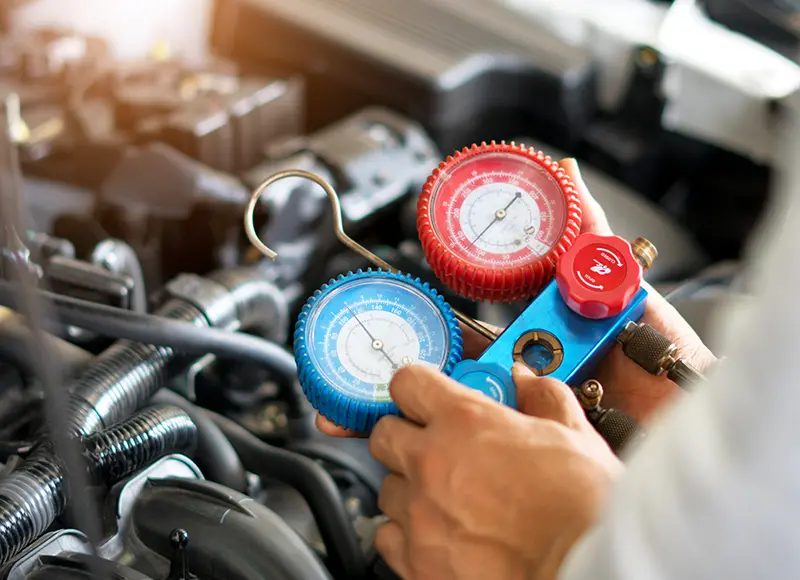
Measuring AC System Pressures and Temperatures
Technicians can use appropriate equipment to evaluate refrigerant pressures and temperatures.
These readings may help identify possible condenser problems, charge issues, restrictions, or compressor performance concerns.
Correct values depend on the vehicle, refrigerant type, outside conditions, and the manufacturer's service procedures.
Checking for Refrigerant Leaks
If refrigerant loss is suspected, professional leak-detection methods may be used to identify the source.
Depending on the findings, the repair may involve a hose, fitting, condenser, seal, or another component.
Proper refrigerant recovery and recharging procedures are important when servicing the system.
Testing Compressor and Electronic Controls
If the airflow and refrigerant conditions appear correct, additional testing may involve compressor performance, electrical controls, sensors, or other climate-system components.
The system should be evaluated before recommending replacement of a costly component such as the compressor.
This approach helps identify the actual reason your Ford's AC stops cooling properly when the vehicle is stationary.
Need Ford AC Repair in Miami, FL?
Midway Ford provides air-conditioning and heater service for Ford owners throughout Miami and nearby communities. If your AC blows cold while driving but warm at idle, describe the conditions when scheduling an appointment so the service team can help evaluate the problem.
Can You Keep Driving if Your Ford AC Blows Warm at Idle?
If the only symptom is reduced air-conditioning performance and the engine temperature remains normal, the issue may not require an immediate roadside stop.
However, you should arrange service rather than repeatedly ignoring the problem, especially if cooling performance continues to worsen.
A cooling fan fault can sometimes affect both the condenser and engine radiator, depending on the vehicle.
That makes it important to monitor other symptoms.
When Should You Stop Driving?
Stop safely and seek qualified assistance if you notice:
- An engine overheating warning or rapidly rising temperature gauge.
- Steam or smoke coming from the engine compartment.
- Severe grinding, squealing, or other unusual mechanical noises.
- A burning smell accompanied by abnormal vehicle operation.
- Another urgent dashboard warning indicating a problem that requires stopping.
If your Ford is overheating, turn off the AC, stop safely, and follow your owner's manual. Do not continue driving simply because the vehicle still moves.
How Can You Help Prevent Ford AC Problems?
Regular inspections and prompt attention to unusual symptoms can help keep your air-conditioning system operating as intended.
Replace Cabin Air Filters as Recommended
A clogged cabin air filter can restrict airflow into the vehicle.
Although it isn't usually the primary cause of strong airflow becoming warm specifically at idle, maintaining the filter can help support comfortable cabin ventilation.
Pay Attention to Gradual Cooling Changes
Air-conditioning problems may develop over time.
If your Ford takes longer to cool the cabin, becomes warmer in traffic, or produces inconsistent vent temperatures, schedule an inspection before cooling performance deteriorates further.
Don't Ignore Refrigerant Leaks
A system with a leak may continue losing refrigerant even after it has been recharged.
Identifying the source of refrigerant loss can help prevent repeated cooling problems.
Maintain the Engine Cooling System
Because some Ford vehicles share cooling fans and front-end airflow between the radiator and AC condenser, proper engine cooling system operation can also affect air-conditioning performance.
Address cooling system warning lights, leaks, and abnormal fan behavior promptly.
Schedule Diagnostics Instead of Guessing at Parts
Replacing an AC compressor or fan without confirming the cause may not correct the problem.
A professional inspection can help determine whether the issue involves refrigerant, condenser airflow, electrical components, or another system.
Frequently Asked Questions About Ford AC That Blows Warm at Idle
Why does my Ford AC blow warm air when stopped but cold air while driving?
One common cause is inadequate airflow across the AC condenser while the vehicle is stationary. A malfunctioning cooling fan, restricted condenser, low refrigerant, or compressor problem may also contribute. Professional diagnostics can help identify the actual cause.
Can a bad cooling fan cause my Ford AC to stop cooling at idle?
Yes. On vehicles that use cooling fans to move air across the AC condenser, a fan problem can reduce cooling performance at low speeds. Natural airflow while driving may temporarily improve the situation.
Does warm AC at idle mean my Ford needs more refrigerant?
Not necessarily. Low refrigerant is one possible cause, but cooling fan faults, restricted condenser airflow, compressor problems, and electronic controls can produce similar symptoms. Adding refrigerant without proper testing may not solve the problem.
Why does my Ford AC get colder when I accelerate?
Changes in engine speed or vehicle speed can affect AC operation, but the reason depends on the vehicle's compressor and cooling-system design. Possible causes include airflow limitations, refrigerant charge problems, compressor faults, or control issues.
Can a bad AC compressor cause warm air at stoplights?
Yes. A compressor that isn't operating correctly may struggle to maintain cooling under certain conditions. However, insufficient condenser airflow and refrigerant problems may produce the same symptoms, so testing should come before replacing the compressor.
Why does my Ford AC work on the highway but not in traffic?
Highway speeds create more natural airflow across the condenser. At low speeds or idle, the system depends more on its cooling fans. If airflow is inadequate or another AC problem exists, cooling performance may become worse in traffic.
Is it normal for AC to be less cold while idling in Miami heat?
Some reduction in cooling performance may occur under extremely hot conditions, depending on the vehicle. However, repeated warm air at every stoplight, particularly when the system previously cooled well, deserves inspection.
Can a clogged cabin air filter make my Ford AC blow warm?
A clogged cabin air filter can reduce airflow through the dashboard vents. However, strong airflow that becomes warm specifically at idle often points toward a different concern, such as condenser airflow or refrigerant-system performance.
Is it safe to drive with AC that only blows warm at idle?
If engine temperature is normal and there are no other concerning symptoms, reduced AC performance alone may not require an immediate stop. However, arrange service promptly. If the engine overheats, steam appears, or severe mechanical noises develop, stop safely and seek assistance.
Should I recharge my Ford AC myself?
Refrigerant systems require the correct refrigerant, charge quantity, and handling procedures. Adding refrigerant without diagnosis may overcharge the system or leave a leak unresolved. Professional inspection is recommended instead of guessing at the required charge.
Where can I get Ford AC repair near Miami, FL?
Midway Ford provides air-conditioning and heater service for Ford owners from Miami, Westchester, Fontainebleau, Sweetwater, and nearby communities. You can schedule service online or contact the service department at 305-646-9053.
Schedule Ford Air Conditioning Service at Midway Ford in Miami
If your Ford AC blows cold while driving but turns warm at stoplights, the problem may involve condenser airflow, cooling fans, refrigerant levels, the compressor, or another component.
The symptom provides a useful clue, but professional testing is the most reliable way to determine what needs repair.
At Midway Ford, our service team offers air-conditioning and heater service, general vehicle diagnostics, and cooling-system repair for Ford drivers throughout Miami, Westchester, Fontainebleau, Sweetwater, and surrounding South Florida communities.
When scheduling an appointment, let us know whether the AC becomes warm only while stopped, whether cooling improves at highway speeds, and whether you've noticed changes in airflow, unusual noises, or engine temperature.
You can also review our current service and parts specials to see whether any applicable maintenance offers are available. AC diagnostics and specific repairs may have separate pricing or eligibility requirements.
Get Your Ford AC Cooling Properly Again
Don't spend another Miami commute wondering why your Ford's air conditioning stops cooling in traffic. Contact Midway Ford to arrange an AC diagnostic inspection and determine the appropriate repair for your vehicle.
Midway Ford
8155 W Flagler St
Miami, FL 33144
Service:
305-646-9053
This article provides general educational information and is not a substitute for professional diagnosis or your Ford owner's manual. AC components, refrigerant types, compressor designs, cooling fans, and electronic controls vary by vehicle and powertrain. Refrigerant systems are pressurized and require appropriate handling and equipment. Electric cooling fans may start unexpectedly even when the engine is off. Do not open refrigerant lines, release refrigerant, or reach near moving components. If an engine overheating warning, steam, or severe mechanical problem occurs, stop safely and follow the manufacturer's instructions.